

- Others
- Other Theater
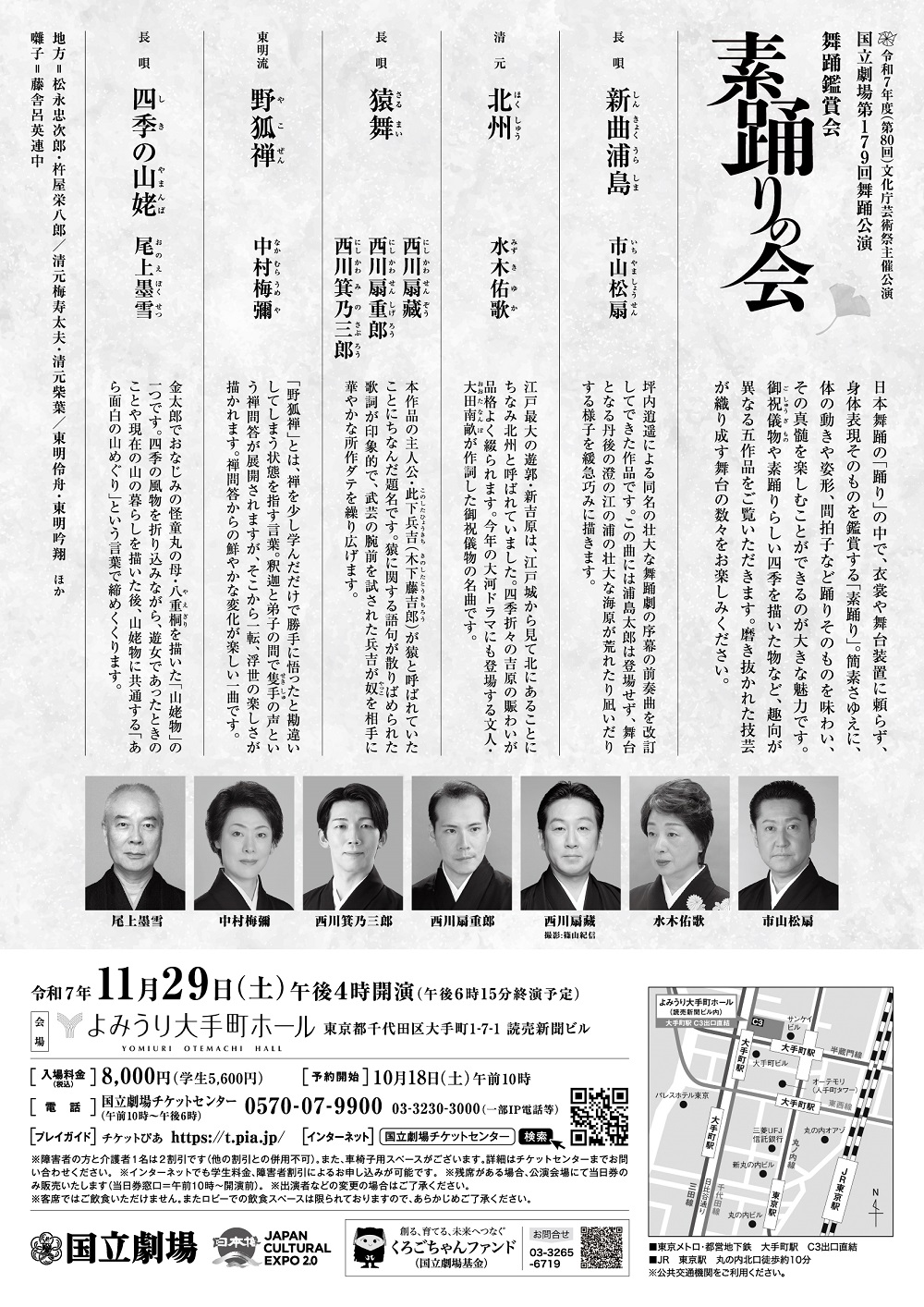
Traditional Japanese Dance Performance
Yomiuri Otemachi Hall
ACA National Arts Festival Presents
Suodori no Kai
Performance Date
November 29 (Sat.), 2025
Performance Time
4:00 p.m. - 6:15 p.m.
*The finish time is an estimate and may vary.
Nagauta Shinkyoku Urashima
ICHIYAMA Shōsen
Kiyomoto Hokushū
MIZUKI Yuka
Nagauta Sarumai
NISHIKAWA Senzō
NISHIKAWA Senshigerō NISHIKAWA Minosaburō
Tōmei-ryū Yakozen
NAKAMURA Umeya
Nagauta Shiki no Yamanba
ONOE Bokusetsu
Organizer: Japan Arts Council, Agency for Cultural Affairs
*English synopsis is available. Please ask at the reception desk.
Tickets (Tax included)
Adults: 8,000 yen (Students: 5,600 yen)
Seating plan
Booking Opens
10:00 a.m., October 18 (Sat.), 2025
*20% discount for audiences with disabilites and one accompanying audience.
*Tickets for students and persons with disabilities for this performance are available online.
*Wheelchair spaces are available. For more details, please contact the Box Office.
*If there are still tickets available for purchase on the day of the event, you may purchase them in person at the Box Office (on-site) for this performance.
Box Office (on-site) : Open from 10:00 a.m. until curtain time.
-----------------------------------------------------------------------------
Box Office
0570-07-9900 (From overseas: +81-3-3230-3000) in Japanese and English (10:00 a.m. - 6:00 p.m.)
Click here to find the details about how to buy tickets.
---------------------------------------------------------
Suodori no Kai
In Tradional Japanese Dance, Suodori refers to performances that do not rely on elaborate costumes or stage props, but focus on the dancer’s body and movement per se. Its simplicity allows audiences to fully appreciate the grace of physical expression, the form and posture of the body, and the nuances of timing—the very essence of the dance. In this program, you will see five pieces with differing themes, including celebratory works (Goshūgimono) and dances depicting the seasons in a style characteristic of Suodori. Please enjoy a series of performances showcasing deft technique and artistry.
Nagauta: Shinkyoku Urashima
This piece was adapted from the prelude to the grand dance drama of the same name by TSUBOUCHI Shōyō. Urashima Tarō does not appear in the music, yet instead, it skillfully depicts the changing moods of the sea at Sumi-no-e Bay in Tango, alternately stormy and calm, with exquisite shifts in tempo and expression.
Kiyomoto: Hokushū
Edo’s largest licensed pleasure district, Shin-Yoshiwara, was called Hokushū because it lay north (“hoku” means north) of Edo Castle. This piece elegantly portrays Yoshiwara’s vibrant life across the four seasons and is a renowned Goshūgimono with lyrics by the literati ŌTA Nanpo.
Nagauta: Sarumai
The title refers to the protagonist, KONOSHITA Hyōkichi (KINOSHITA Tōkichirō), who was called a monkey (“saru”means monkey). The lyrics, scattered with references to monkeys, leave a defining impression, while Hyōkichi, whose martial skills are tested, performs dazzling movements and theatrical gestures in a display of bravura before his opponent.
Tōmei-ryū: Yakozen
“Yakozen” refers to the state of mistakenly thinking one has had an epiphany after only a brief study of Zen. This piece presents a Zen riddle between Shaka and his disciple, known as the “voice of one hand,” which suddenly gives way to a lively depiction of worldly pleasures. It is an entertaining piece that unfolds through a vivid, playful shift from a Zen riddle.
Nagauta: Shiki no Yamanba
This piece is one of the Yamanbamono, which depict Yaegiri—the mother of Kaidōmaru, better known as Kintarō. Blending scenes of the four seasons, it portrays her past as a courtesan and her present life in the mountains, concluding with the familiar line common to the Yamanbamono: “Ah, the pleasure of this journey through the mountains.”