

- Others
- Other Theater
Traditional Japanese Dance Performance
Yomiuri Otemachi Hall
ACA National Arts Festival Presents
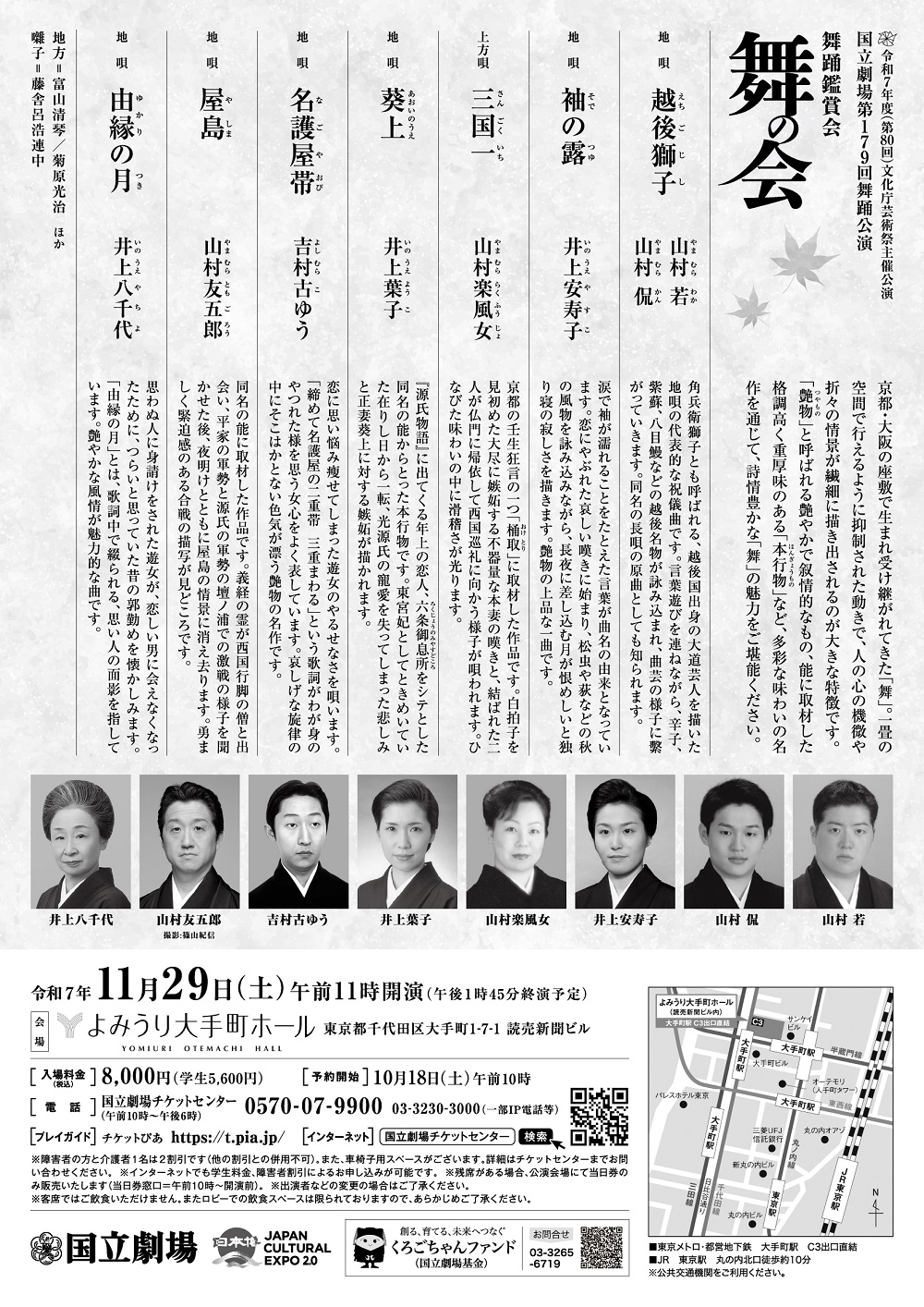
Mai no Kai
Performance Date
November 29 (Sat.), 2025
Performance Time
11:00 a.m. - 1:45 p.m.
*The finish time is an estimate and may vary.
Jiuta Echigojishi
YAMAMURA Waka, YAMAMURA Kan
Jiuta Sode no Tsuyu
INOUE Yasuko
Kamigatauta Sangokuichi
YAMAMURA Rakufūjo
Jiuta Aoi no Ue
INOUE Yōko
Jiuta Nagoyaobi
YOSHIMURA Koyū
Jiuta Yashima
YAMAMURA Tomogorō
Jiuta Yukari no Tsuki
INOUE Yachiyo
Jikata (Music accompanists) : TOMIYAMA Seikin, KIKUHARA Kōji and others
Hayashi (Percussion instrument) : TōSHA Rokō ensemble
Organizer: Japan Arts Council, Agency for Cultural Affairs
*English synopsis is available. Please ask at the reception desk.
Tickets (Tax included)
Adluts: 8,000 yen (Students: 5,600 yen)
Seating plan
Booking Opens
10:00 a.m., October 18 (Sat.), 2025
*20% discount for audiences with disabilites and one accompanying audience.
*Tickets for students and persons with disabilities for this performance are available online.
*Wheelchair spaces are available. For more details, please contact the Box Office.
*If there are still tickets available for purchase on the day of the event, you may purchase them in person at the Box Office (on-site) for this performance.
Box Office (on-site) : Open from 10:00 a.m. until curtain time.
-----------------------------------------------------------------------------
Box Office
0570-07-9900 (From overseas: +81-3-3230-3000) in Japanese and English (10:00 a.m. - 6:00 p.m.)
Click here to find the details about how to buy tickets.
---------------------------------------------------------
Mai no Kai
Mai was born and passed down in the zashiki (tatami rooms) of Kyoto and Osaka. Its distinctive feature is the restrained movement within the limited space of a single tatami mat, delicately expressing the subtleties of human emotions and a variety of scenes.
Please enjoy the poetic charm of Mai through magnum opuses in diverse styles, from the lustrous and lyrical Tsuyamono to the rich and refined Hongyōmono, inspired by Noh.
Jiuta: Echigo Jishi
Also called Kakubē Jishi, this is a representative celebratory Jiuta song depicting a street performer from Echigo Province. An array of playful words weaves Echigo’s local specialties—such as mustard, shiso, and Yatsume-unagi (eel)—into the lyrics, connecting them to the performer’s acrobatic feats. It is also known as the original piece for the Nagauta song of the same name.
Jiuta: Sode no Tsuyu
The title comes from the image of sleeves wet with tears. The piece begins with a poignant lament over lost love and, weaving in autumnal imagery such as pine crickets and Japanese bush clover, evokes the loneliness of sleeping alone under the moonlight streaming through the long night.
Kamigatauta: Sangokuichi
This piece is based on “Oketori”—one of the Mibu Kyōgen plays of Kyoto. It follows the story of an unattractive wife’s envious lament over her husband’s affection for a shirabyōshi dancer, and later the couple’s devotion as they turn to Buddhism and set out on a pilgrimage through western Japan. The rustic flavor of the piece is tinged with comedic grace.
Jiuta: Aoi no Ue
This piece is a main narrative derived from the Noh play of the same name, with the older lover, Rokujō no Miyasudokoro, from The Tale of Genji, as the shite (main actor). It depicts her sorrow at losing the favor of Hikaru Genji—once the object of her heart as the consort of the Eastern Palace—and her jealousy toward his principal wife, Aoi no Ue.
Jiuta: Nagoya Obi
This piece expresses the sorrow and frustration of a courtesan who has grown thin from the torment of love. The lyrics, “Tying the Nagoya double obi, wrapped thrice around,” vividly convey her sense of personal weariness. Amid the poignant melody, a subtle, lingering sensuality emanates from this Tsuyamono.
Jiuta: Yashima
This piece is based on the Noh play of the same name. The spirit of Yoshitsune encounters a pilgrim monk in western Japan and recounts the fierce battle between the Heike and Genji clans at Dan-no-ura; by dawn, he vanishes into the scenery of Yashima. The valiant and tense depiction of the battle is a highlight of the piece.
Jiuta: Yukari no Tsuki
A courtesan, unexpectedly purchased by another, finds herself unable to see the man she loves and looks back with nostalgia on her former life in the pleasure quarters, which she once found difficult. The “Yukari no Tsuki” refers to the image of her beloved, woven throughout the lyrics. It is a captivating piece that emanates a lustrous, sensuous ambiance.