
- Bunraku
- Other Theater
Bunraku Performance in February
Bunraku Performance in February
Venue: KAAT Kanagawa Arts Theatre <Hall>
Performance Dates
February 11 (Wed.) - February 23 (Mon.), 2026
No performance on 16 (Mon.)
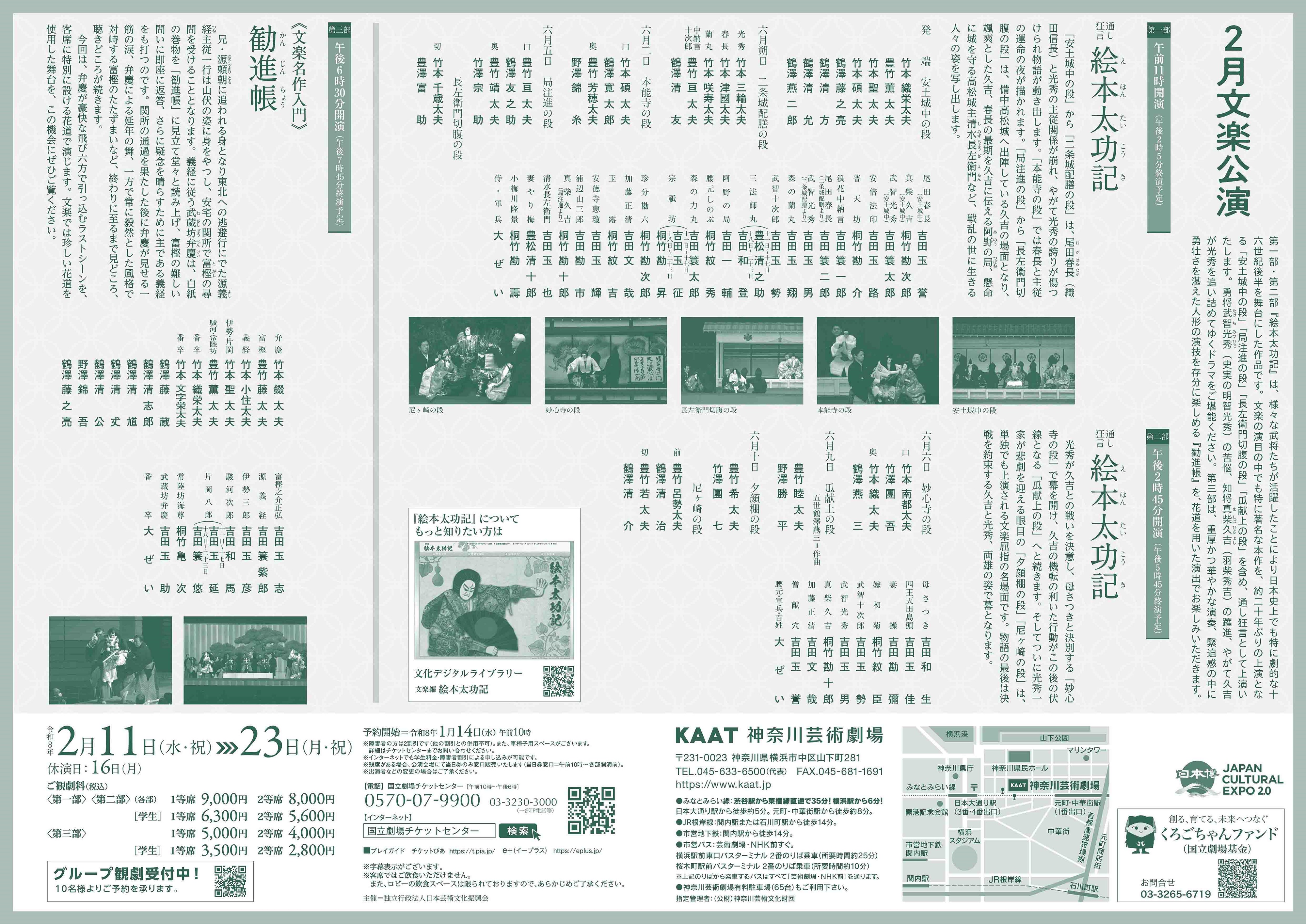
Program Ⅰ (11:00 a.m. – 2:05 p.m.)
Ehon Taikōki Part 1
Program II (2:45 p.m. - 5:45 p.m.)
Ehon Taikōki Part 2
Program III(6:30 p.m. - 7:45 p.m.)
Kanjinchō
Ticket Prices (tax included)
(ProgramI / ProgramII)
Adults: [1st Grade] ¥9,000 [2nd Grade] ¥8,000
Students: [1st Grade] ¥6,300 [2nd Grade] ¥5,600
(ProgramIII)
Adults: [1st Grade] ¥5,000 [2nd Grade] ¥4,000
Students: [1st Grade] ¥3,500 [2nd Grade] ¥2,800
Seating plan [PDF/1226KB]
*Only first floor seats are available.
*Japanese and English audio guides are available for rent. Click here for details of audio guide.
*Subtitles: Available only in Japanese.
*English synopsis is available. It is included in the paid Japanese brochure.

Booking Opens
January 14 (Wed.), 2026
*If there are still tickets available for purchase on the day of the event, you may purchase them in person at the Box Office (on-site) for this performance.
Box Office (on-site) : Open from 10:00 a.m. until each curtain time.
*Tickets for students and persons with disabilities for this performance are available online.
*Wheelchair spaces are available. For more details, please contact the Box Office.
-----------------------------------------------------------------------------
Box Office (by phone)
0570-07-9900 (From overseas: +81-3-3230-3000) in Japanese and English (10:00 a.m. - 6:00 p.m.)
Click here to find the details about how to buy tickets.
-----------------------------------------------------------------------------
in Japanese
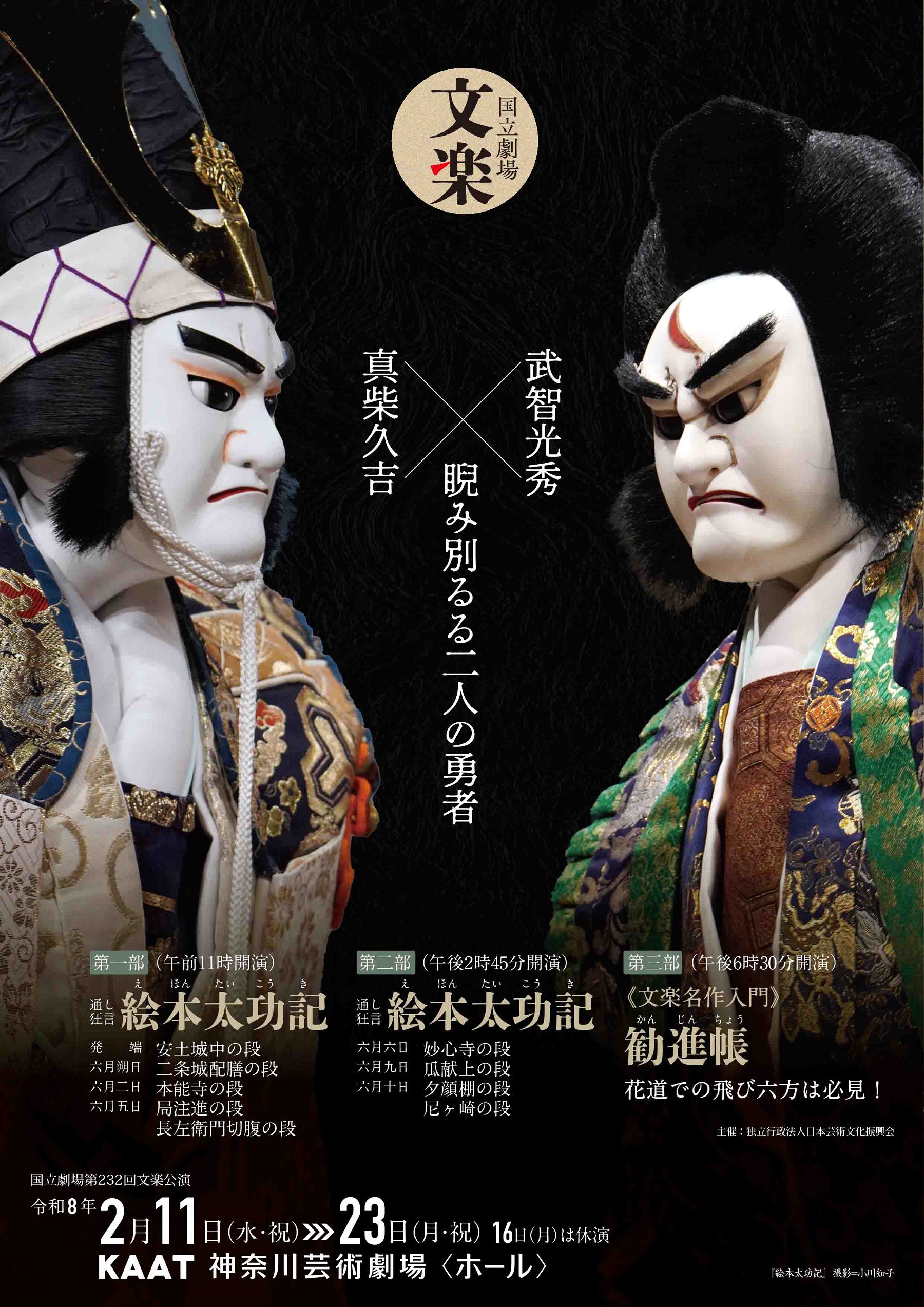
Bunraku is a traditional Japanese theatrical art, where the story and characters’ emotions are expressed through "Jōruri" performed by "Tayū (chanters)" and "Shamisen players,” while the "Ningyō-Tsukai (puppeteers)," three puppeteers working in unison, manipulate a single puppet.
*Shamisen is a traditional instrument with three strings.
Parts Ⅰ and Ⅱ feature the performance of "Ehon Taikōki," a play that brings to life the exploits of various warlords. This work is inspired by the Honnōji Incident, one of the most dramatic episodes in Japanese history, which took place in the late 16th century. As ODA Nobunaga stood on the brink of uniting the nation, he was betrayed by his vassal, AKECHI Mitsuhide, and driven to his tragic end. The narrative is vividly dramatized, centering on Mitsuhide’s actions before and after the incident, and explores the ensuing drama as HASHIBA Hideyoshi pursues Mitsuhide, carrying on Nobunaga’s legacy.
Part Ⅰ (starting at 11:00 a.m.) opens with the breakdown of the relationship between ODA Harunaga (representing the historical ODA Nobunaga) and TAKECHI Mitsuhide (the historical AKECHI Mitsuhide), wounding Mitsuhide’s pride and setting the story in motion. The "Honnōji Scene" portrays the fateful night between Harunaga and his vassals. Noteworthy moments include Harunaga’s mistress delivering news of his demise to MASHIBA Hisayoshi (the historical HASHIBA Hideyoshi), who had left his master, and the seppuku of SHIMIZU Chōzaemon, who defends the castle besieged by Hisayoshi. These scenes, rooted in actual events, offer a vivid glimpse into the lives of those who endured this turbulent era.
In Part Ⅱ (starting at 2:45 p.m.), Mitsuhide, having resolved to confront Hisayoshi, severs ties with his mother Satsuki, who cannot forgive his betrayal in killing his master. This decision leads the Mitsuhide family toward a tragic climax. The highlight, "Amagasaki Scene," stands as one of Bunraku’s most celebrated scenes, often performed independently. Mitsuhide’s anguish and sorrow as a traitor who sacrifices his family are portrayed with moving intensity. The act concludes with Hisayoshi and Mitsuhide vowing to meet on the battlefield.
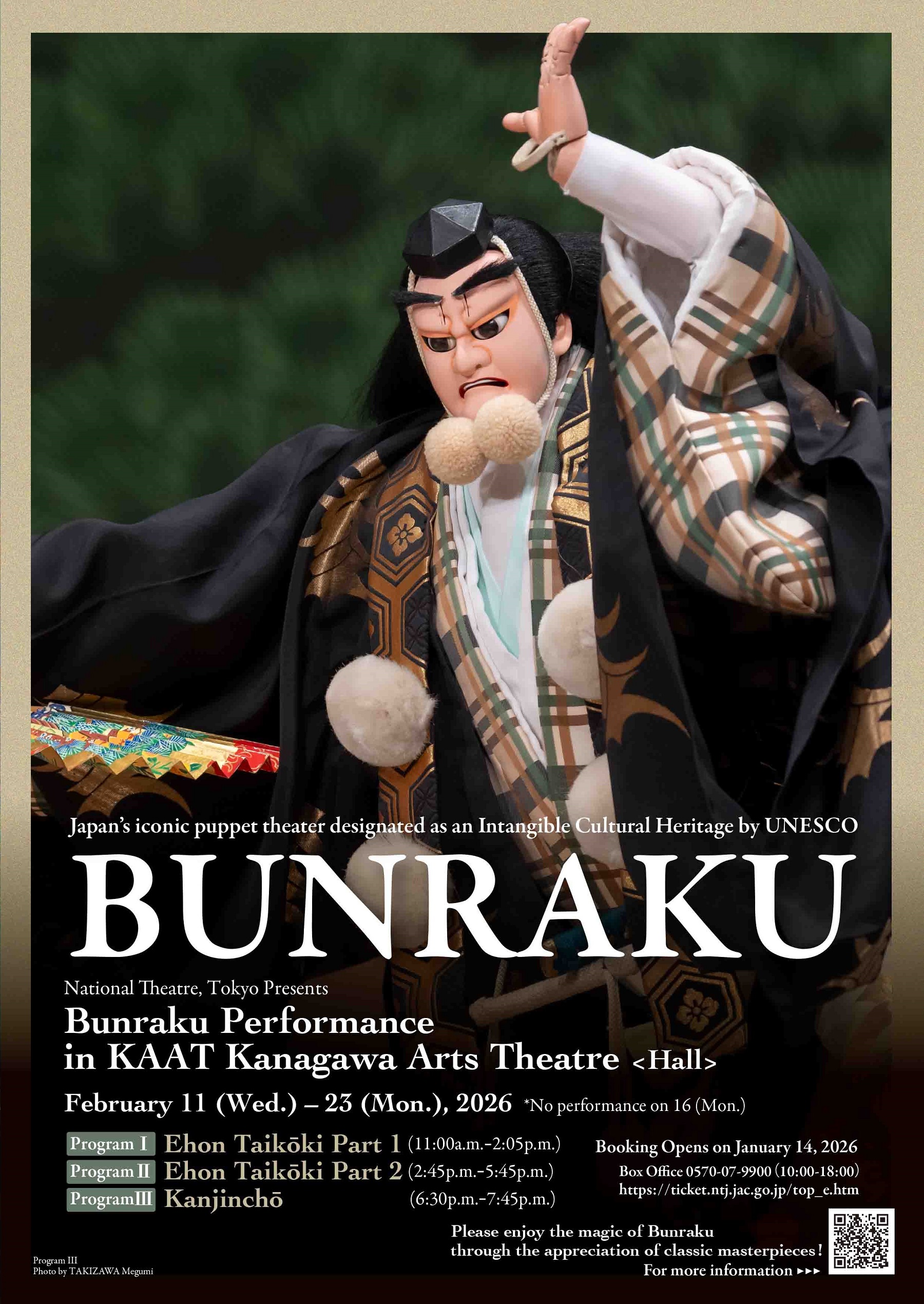
Part Ⅲ (starting at 6:30 p.m.) is a concise, 75-minute performance designed as an introduction to the world of Bunraku—perfect for newcomers. This portion features "Kanjinchō," which tells the story of the 12th-century warlord Minamoto no Yoshitsune and his conflict with his brother Yoritomo, resulting in Yoshitsune’s flight to the Tōhoku region. The dynamic exchanges between Musashibō Benkei (Yoshitsune’s loyal retainer) and Togashi (his pursuer) are particularly engaging. The performance showcases Bunraku’s intriguing music and expressive puppet movements, especially in Benkei’s featured scene. The finale, the dramatic "tobi roppō"—where Benkei energetically runs with arms waving and feet stomping—takes place on a special “hanamichi (runway)” set among the audience, a rare feature in Bunraku, creating a thrilling spectacle.