

- Others
- Other Theater
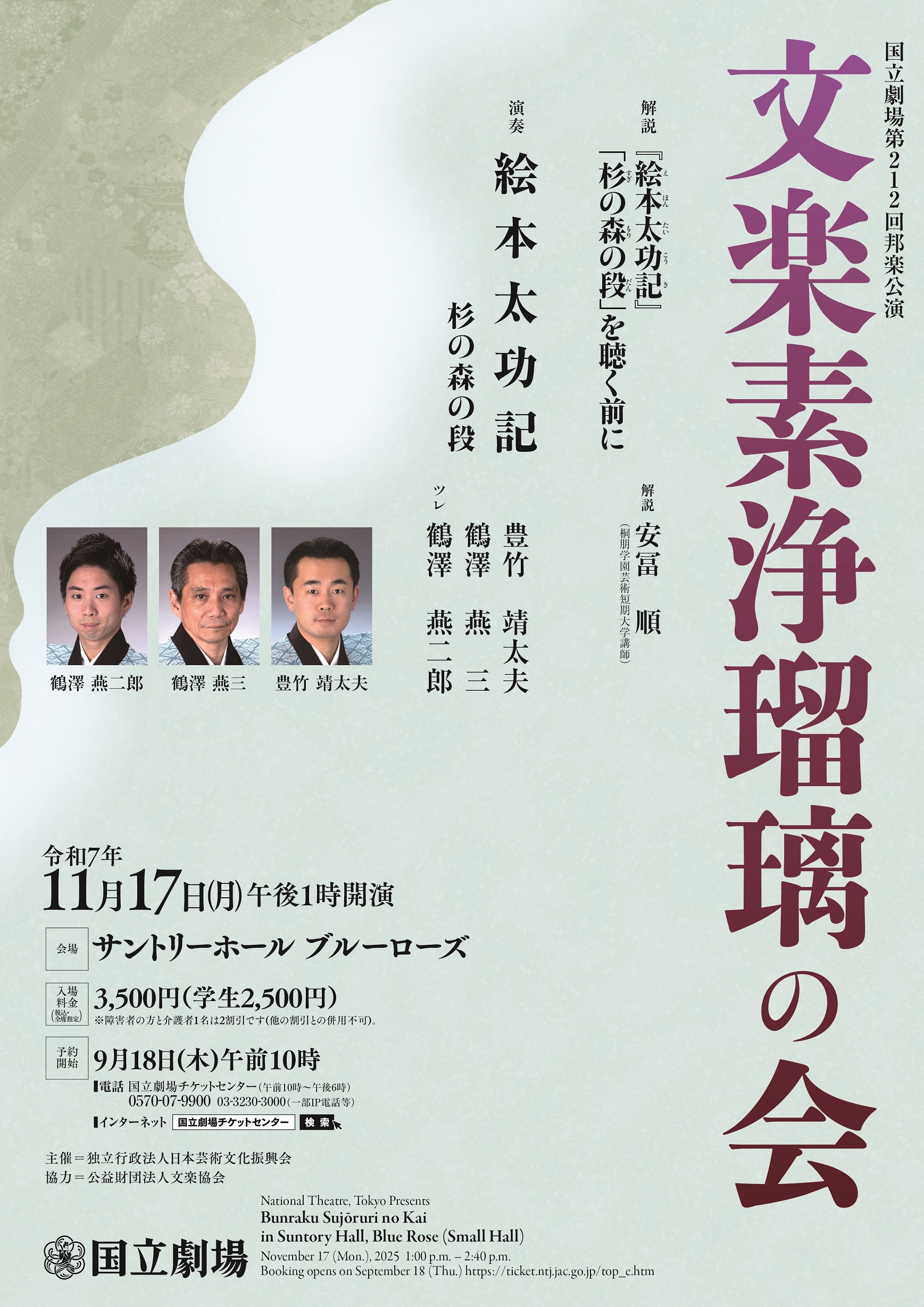
Bunraku Sujōruri no Kai
Suntory Hall, Blue Rose (Small Hall)
Bunraku Sujōruri no Kai
Performance Date
November 17(Mon.), 2025
Performance Time
1:00 p.m. - 2:40 p.m.
*The finish time is an estimate and may vary.
Commentary
The Background of "Suginomori no dan"
YASUTOMI Jun
Performance
Suginomori no dan from "Ehon Taikōki"
TOYOTAKE Yasutayū
TSURUZAWA Enza
TSURUZAWA Enjirō
*English synopsis is available. Please ask at the reception desk.
Tickets (Tax included)
Adults: 3,500 yen ( Students: 2,500 yen )
Seating plan
Booking Opens
10:00 a.m., September 18(Thu), 2025
*20% discount for audiences with disabilites and one accompanying audience.
*Tickets for students and persons with disabilities for this performance are available online.
*Wheelchair spaces are available. For more details, please contact the Box Office.
*If there are still tickets available for purchase on the day of the event, you may purchase them in person at the Box Office (on-site) for this performance. Box Office (on-site) : Open from 12:00 p.m. until curtain time.
-----------------------------------------------------------------------------
Box Office
0570-07-9900 (From overseas: +81-3-3230-3000) in English and Japanese
(10:00 a.m. - 6:00 p.m. )
Click here to find the details about how to buy tickets.
In Bunraku—puppet theater native to Japan—the progression of the drama is guided by a form of classical music called Gidayū-bushi. In Gidayū-bushi, a tayū narrates the story, accompanied by shamisen performance, expressing every element of the drama, from the characters’ dialogue and emotions to the scenery. In this performance, you can enjoy the drama of Bunraku without the puppets, experiencing it through Gidayū-bushi alone.
At the end of the 16th century in Japan, many warlords fought for national unification. Among them were ODA Nobunaga, who came close to achieving hegemony but was killed by his retainer AKECHI Mitsuhide, and TOYOTOMI Hideyoshi, who inherited Nobunaga’s power and succeeded in unifying the country. This performance, Ehon Taikōki, is one of Bunraku’s representative plays, renowned as a magnum opus for its engaging story and captivating music, and boldly dramatizes the historical events surrounding Nobunaga, Hideyoshi, and Mitsuhide.
In the act called “Suginomori no dan (Fortress in a Cedar Forest Scene),” the three warlords do not appear; however, the drama centers on a family of Nobunaga’s opposing faction, struggling amid the conflict. The delicate yet dynamic traditional performance vividly conveys the protagonist’s emotions, torn between loyalty and filial love, as well as the family’s tragic fate.
(Synopsis)
Honganji, a branch of Buddhism, makes a peace pact with its foe, Harunaga (Nobunaga); however, Harunaga breaks the treaty and resumes his attack. At a Honganji fortress, Shigenari, who protects his lord Keigaku, has disowned his son, Magoichi. Magoichi comes to the fortress to beg for pardon, yet is unable to do so as he is wounded in battle and with his young son by his side. At that moment, Magoichi covertly learns that Harunaga has been killed by Mitsuhide. Seizing this opportunity to make peace with Harunaga’s retainer, Hisayoshi (Hideyoshi), Magoichi resolves to offer his life to the lord on behalf of his father. Restraining his wife, who tries to stop him, he instructs his son and daughter to sever his head after he commits seppuku—however...